🧩 What Are Blockchain Oracles?
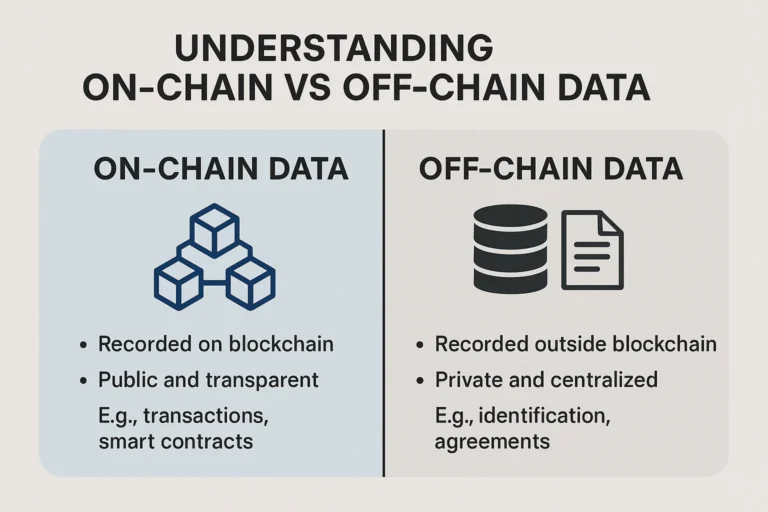
Blockchain Oracles are third-party services that provide external data to smart contracts on the blockchain. Since blockchains are closed systems that can’t access data outside their network, oracles act as bridges between off-chain (real-world) data and on-chain applications.
At bit2050.com, we believe understanding oracles is key to grasping the full potential of decentralized apps (dApps) and Web3 platforms.
📦 Why Are Blockchain Oracles Important?
Smart contracts can execute autonomously, but they need data like weather conditions, sports results, or asset prices to function correctly. Here’s how oracles help:
-
📈 Price Feeds: Oracles provide real-time asset prices to DeFi platforms like Aave and Compound.
-
🌦️ Weather Data: Useful for decentralized insurance contracts.
-
⚽ Sports Results: Enables smart contracts for betting and gaming platforms.
-
🏦 APIs & Web Data: Connects blockchains to traditional web APIs.
🔗 Types of Blockchain Oracles
🧭 1. Software Oracles
Pull data from online sources such as websites and APIs (e.g., stock prices, news updates).
🚛 2. Hardware Oracles
Connect real-world physical sensors to blockchain (e.g., tracking supply chain temperature).
🌐 3. Inbound vs Outbound Oracles
-
Inbound: Brings external data into the blockchain.
-
Outbound: Sends blockchain data out to external systems.
👥 4. Centralized vs Decentralized Oracles
-
Centralized: One source of data (risk of manipulation).
-
Decentralized: Multiple sources, consensus-based, more secure.
⚙️ How Do Blockchain Oracles Work?
-
A smart contract requests data.
-
An oracle fetches the required information from off-chain sources.
-
It verifies and transmits the data to the blockchain.
-
The smart contract uses the data to execute predefined conditions.
Popular oracle networks like Chainlink and Band Protocol are built to do this securely and reliably.
🚀 Use Cases of Blockchain Oracles
-
💸 Decentralized Finance (DeFi) – Real-time price feeds
-
🏥 Healthcare – Secure transfer of medical records with time stamps
-
📦 Supply Chain – GPS or temperature data from IoT sensors
-
🎮 Gaming & NFTs – Real-world event triggers for in-game effects
For more real-world applications, check out our post on Use Cases of Blockchain Beyond Crypto.
🛡️ Challenges with Blockchain Oracles
-
Security risks: A single faulty or malicious oracle can compromise a smart contract.
-
Latency: Real-time data delays can affect decision-making.
-
Centralization: Relying on one data source undermines decentralization.
🔮 The Future of Blockchain Oracles
With Web3 growth, oracles are becoming smarter and more decentralized. Hybrid models and AI-integrated oracles may soon offer faster, more reliable, and censorship-resistant data delivery. The rise of zero-knowledge proofs (ZKPs) may also help validate data without revealing private information.
❓ Frequently Asked Questions (FAQ)
🔹 What is a blockchain oracle in simple terms?
A blockchain oracle is a tool that sends external data (like weather or price info) to a smart contract so it can run correctly.
🔹 Are blockchain oracles decentralized?
They can be. Some use multiple data sources to improve reliability and security, like Chainlink.
🔹 Is Chainlink the only oracle?
No, other oracles include Band Protocol, API3, DIA, and Nest.
🔹 Can oracles be hacked?
If improperly implemented or centralized, they can be. That’s why decentralized oracle networks are safer.
🔹 Where can I learn more?
You can explore more educational content at bit2050.com — your trusted source for blockchain insights.
🏷️ Tags:
Blockchain Oracles, Smart Contracts, Web3, Chainlink, Crypto Data Feeds, Blockchain Explained, Oracle Network, DeFi, Blockchain Technology