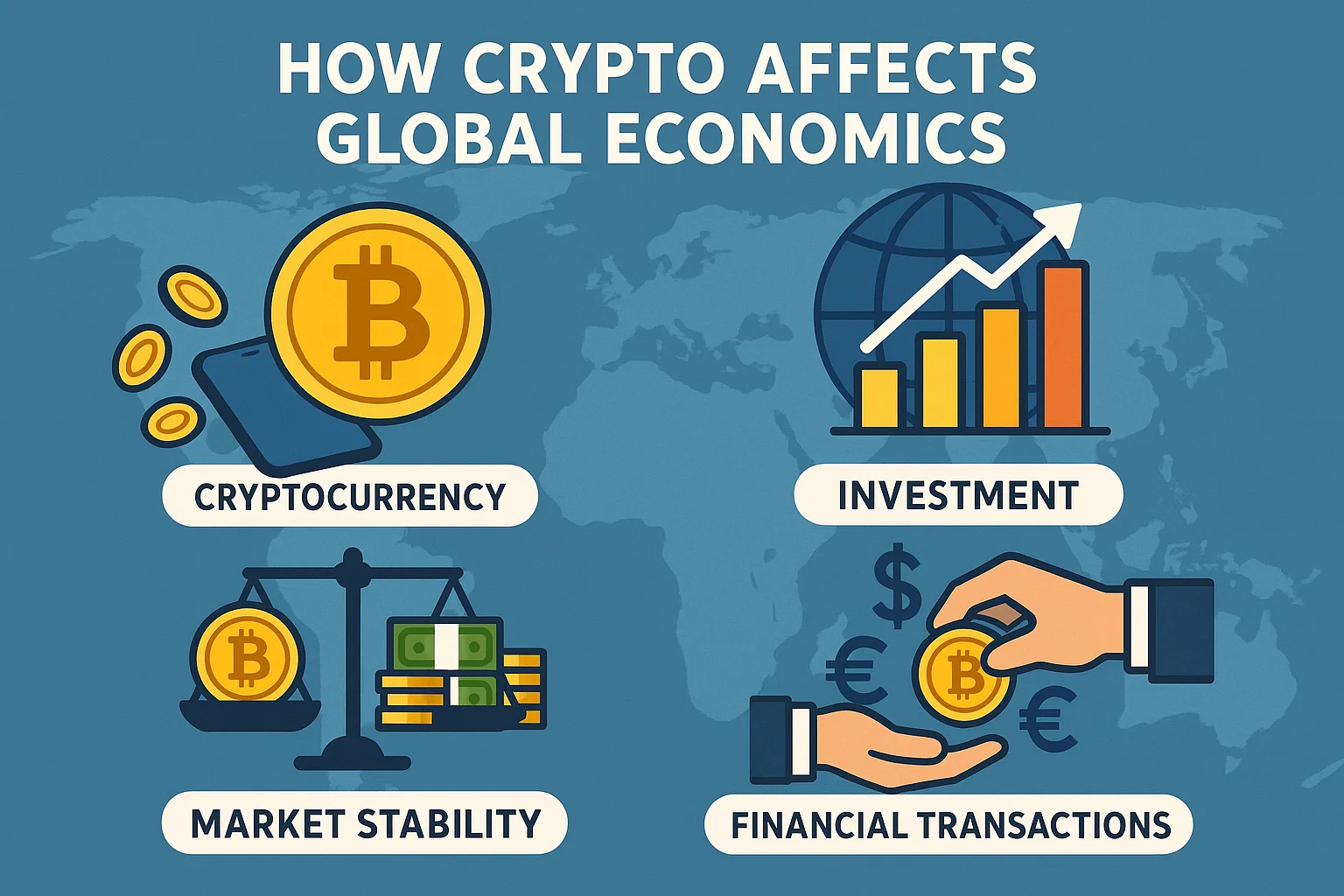

🌍 How Crypto Affects Global Economics – 9 Shocking Impacts in 2025
Cryptocurrencies are no longer fringe experiments. In 2025, they are rapidly influencing global economics, shaking the pillars of traditional financial systems, altering inflation strategies, and shifting global power dynamics.
Let’s explore how crypto affects global economics in 9 powerful ways — from central banks to emerging markets.
🌐 1. Decentralization Challenges Central Banks
The rise of Bitcoin and Ethereum reduces dependence on traditional monetary systems. This weakens the control central banks have over:
-
Currency issuance
-
Interest rates
-
Inflation policy
🏦 2. Redefining Cross-Border Payments
With blockchain, international payments are now faster and cheaper:
-
No intermediaries
-
Instant settlements
-
Reduced transaction fees
This is reshaping remittances and international trade finance.
💸 3. Stablecoins vs National Currencies
Stablecoins like USDT and USDC are being used as everyday money in countries with:
-
Hyperinflation (e.g., Venezuela, Argentina)
-
Unstable banks (e.g., Lebanon)
This reduces trust in fiat currencies, leading to de-dollarization in some cases.
📉 4. Inflation Hedge Narrative
Bitcoin is often considered “digital gold.” In economies battling inflation, crypto is viewed as a hedge, influencing:
-
Investment patterns
-
Public sentiment
-
Government policy on inflation
📊 5. Financial Inclusion in Underbanked Nations
DeFi platforms allow anyone with a smartphone to:
-
Lend and borrow
-
Earn interest
-
Access global assets
This democratizes finance and boosts local economic activity in regions like Africa and South Asia.
🪙 6. Sovereign Digital Currencies (CBDCs)
Countries like China, India, and the EU are launching Central Bank Digital Currencies in response to crypto adoption, balancing innovation with control.
CBDCs aim to:
-
Maintain monetary control
-
Enable programmable money
-
Monitor capital flows
💼 7. Job Creation & New Economies
Crypto is creating global job markets in:
-
Web3 development
-
Content monetization
-
DAO governance
-
NFT & gaming economies
Entire economies are forming in virtual metaverses.
🚨 8. Regulatory Arms Race
As crypto usage spreads, global institutions (IMF, FATF, SEC) are enforcing stricter policies, influencing:
-
Taxation
-
AML/KYC standards
-
Exchange compliance
This also affects global capital flows and investment behavior.
🪙 9. Reserve Asset Debate
Some nations (e.g., El Salvador) now hold Bitcoin in national reserves, sparking debates over crypto’s future as a global reserve asset.
🔗 Useful Links – bit2050.com
🌐 Resources
❓ FAQ – How Crypto Affects Global Economics
Q1: Can crypto replace national currencies?
A: Not completely, but it is challenging fiat dominance in unstable economies and forcing governments to innovate.
Q2: Is crypto helping or hurting global finance?
A: Both. It enhances efficiency and access, but creates regulatory and monetary challenges.
Q3: What role do stablecoins play?
A: Stablecoins offer price stability and are widely used in trading, payments, and savings in emerging economies.
Q4: How is crypto regulated globally?
A: Regulation varies. The US, EU, India, and China have different frameworks. A global regulatory consensus is still forming.
Q5: Could crypto lead to a new global financial system?
A: Yes. Crypto and blockchain could support a decentralized financial order, reducing reliance on SWIFT and USD dominance.
✅ Final Thoughts
Understanding how crypto affects global economics is essential in 2025. As adoption grows, expect major shifts in monetary policy, trade, and international cooperation. Stay ahead by following deep-dive insights at bit2050.com — your hub for blockchain and future finance.