

📌 Introduction
If you’re a freelancer, gig worker, or entrepreneur, you already know the struggle: money comes in waves, but bills are steady. So how do you stay financially afloat?
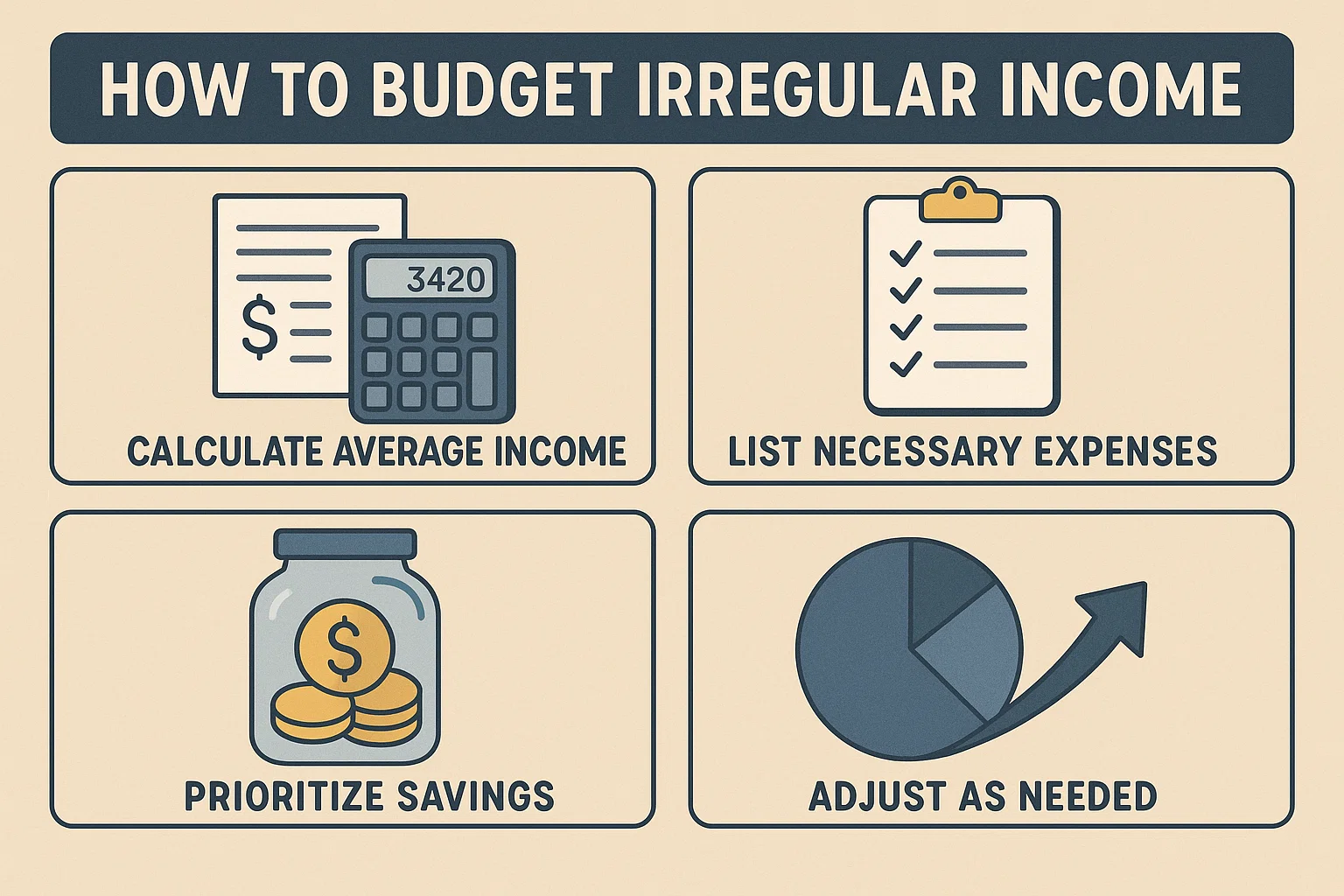
This is where learning how to budget irregular income becomes essential. In this guide, we’ll share 7 proven strategies to bring stability and structure to your unpredictable earnings.
💡 How to Budget Irregular Income – 7 Proven Strategies
1. 🎯 Know Your Bare Minimum
Calculate your monthly essential expenses (rent, food, EMI, utilities).
👉 This is your survival budget — the amount you must cover each month.
2. 📊 Average Your Last 6 Months’ Income
Add your past 6 months’ earnings → divide by 6.
Use this average to build a realistic monthly budget.
3. 💸 Pay Yourself a Salary
Even if you earn ₹1.5L this month and ₹30K next, pay yourself a fixed monthly amount (e.g., ₹50K).
Save the surplus in a buffer account.
4. 💼 Build an Income Buffer
Aim for 3–6 months of essential expenses in a separate buffer account.
This will protect you during low-income months.
5. 📅 Prioritize Fixed Expenses
Automate essentials first:
-
Rent
-
EMI
-
Insurance
-
Utility bills
Discretionary spending comes after saving for these.
6. 📁 Use the 50/30/20 Rule (Flex Version)
-
50% Essentials
-
30% Variable lifestyle
-
20% Savings/Investments
Adjust these percentages based on high/low-income months.
7. 🧾 Track Income and Expenses Monthly
Use tools like Google Sheets, YNAB, or Wallet App.
Tracking prevents overspending and helps spot patterns.
🧾 Sample Budget for Irregular Income Earner
| Category | Monthly Budget (₹) |
|---|---|
| Essentials | 30,000 |
| Buffer Savings | 10,000 |
| SIP/Investments | 5,000 |
| Lifestyle | 5,000 |
| Total Target | 50,000 |
Income above ₹50,000? Allocate to buffer or investments.
🔗 Useful Links – bit2050.com
🌐 Resources
❓ FAQ – How to Budget Irregular Income
Q1. Who needs to budget irregular income?
Freelancers, consultants, gig workers, small business owners — anyone without a fixed monthly paycheck.
Q2. What if I have zero income in a month?
Use your buffer savings to cover essentials, then replenish it when income resumes.
Q3. Should I stop investing during low-income months?
If needed, pause SIPs temporarily — but always restart ASAP. Consider flexible SIPs or liquid funds.
Q4. How much should I keep as a buffer?
Aim for 3–6 months of essential expenses, stored in a savings account or liquid fund.
Q5. Can I still achieve my financial goals with irregular income?
Absolutely. It just requires discipline, flexibility, and planning.
✅ Final Thoughts
Mastering how to budget irregular income isn’t about rigid rules—it’s about building a system that keeps you calm during income drops and smart during windfalls.
Start with your minimum needs, automate your essentials, and build a strong buffer. With the right plan, you’ll thrive in financial unpredictability.
Let bit2050.com help you budget like a pro—no matter how lumpy your income is.


